Why does school accountability matter?

Public education leaders in Washington have developed a first draft of their statewide education plan. This plan is a requirement as part of ESSA, and state leaders say they’ll submit the final version to the U.S. Education Department by the Sept. 18 deadline.

A major chunk of the plan is dedicated to school accountability: Knowing how well schools are meeting the academic needs of students, showing that information to parents, and helping schools that are struggling the most.

We'll get into the details of the first draft of Washington's consolidated plan, and we'll try to figure out what it all means. In the meantime, I want to remind myself why this is important.

Read More

Principal Drake is leaving Emerson Elementary

Dr. Andrea Drake will be resigning as principal at Emerson Elementary at the end of the school year to take another position with Seattle Public Schools. Her two years at Emerson were marked by high staff turnover and a leave of absence last fall that sparked controversy.

Here is the letter that went out by email to Emerson parents:

Dear Emerson Elementary Staff and Families,
I am writing to let you know that after much consideration, I have accepted a position in the Seattle Public Schools district office to support the Eliminating Opportunity Gaps work. It was a difficult decision because I have enjoyed serving as your principal so much and I am proud of the progress we have made together; but I am excited to approach this new chapter. I will still be a part of Seattle Public Schools, as I take on a body of work that I am personally passionate about. In my new role, I will have the opportunity to help design culturally responsive school supports and aid the entire district in eliminating  opportunity gaps. My start date will be July 1, 2017.
Leaving Emerson staff, students, and families will be difficult. In a short time, we have made great progress in implementing our vision and goal to maximize daily instruction, reengage our families and community, and improve student attendance, in an effort to accelerate the academic achievement of our scholars. Emerson Elementary is an amazing learning community that prides itself on working together to make a difference in the lives of students, and I have valued being a part of it.
As we work together to finish out the school year, the district office will begin the process of working with staff and families to identify the qualities the school community is looking for in its next leader. Staff and families will both be represented on the hiring team to ensure a good fit. I am confident that Emerson Elementary will be in good hands. I will finish out this year and work closely with staff to ensure a smooth transition to the 2017-18 year; I know our staff will also continue on the path we have laid together.
Thank you for embracing and supporting me these past years. Emerson Elementary will always have a very special place in my heart. I know Emerson Elementary Eagles will continue to SOAR higher because of families and staff like you. I will truly miss you and wish you all the best and look forward to supporting you in my new role.
Sincerely,
Andrea Drake, Ed.D.
Principal, Emerson Elementary School
 

I wish Dr. Drake all the best in her new role, and I look forward to hearing about the progress she and the district are able to make in closing our persistently appalling opportunity gaps. This is all about the principle, not the principal.

Dr. Drake stepped in less than two years ago as principal of a school long suffering from systemic neglect. That's not exactly an easy job. She also took a mysterious and much-discussed leave of absence last fall. In the end, her tenure as Emerson's principal was short and tumultuous, just like all of her recent predecessors. She wasn't able to beat a broken system.

Drake's replacement will (if you count Barbara Moore, Drake's temporary replacement last fall who has remained on staff) be Emerson's fourth principal in four years. Think about that. My son will, as a third grader, have his fourth different principal at the helm next fall.

So, clearly this is nothing new. It's no surprise, then, that my questions are also recycled (from my Oct. 24, 2016 post):

"It seems clear that our [last] state superintendent (Dorn), our region’s ED with SPS (Aramaki) and our locally elected school board rep (Patu) are all well aware of the problems at Emerson.
Our leaders know that our school is failing us. This is, in theory, why we elected them, why our taxes pay their salaries. They are our advocates, a mouthpiece for the students and families in the communities they serve. And they know that our kids are being treated inequitably.
So, what’s going to be different this time? What will be done to change Emerson’s future and give our kids access to the education they deserve from their neighborhood school?"

Of course, if we keep asking the same questions, we can expect to keep getting the same answers. I don't expect the broken system that created and perpetuates this inequitable environment to magically turn around and start working in Emerson's favor.

This is why school accountability is so important. Our leaders know that Emerson's needs are not being met, that it is struggling with intense staff turnover and operating on scant resources, all while trying to serve a high-need population of students.

Our system is failing to hold our schools and districts accountable, and we as parents and community members have no true levers to force change.

So, in the end, it comes back to hope. To searching as parents for a reason to believe that this is the time things will be different. We will have a new principal at Emerson again next fall. Hopefully he or she will be a transformational leader who will guide Emerson all the way into some new and brighter days. It can be done, that much I know. But history tells us not to hold our breath.

I suppose the real question is whether or not it's worth more years of our children's lives to find out whether Emerson can turn around. For now, we just keep hoping for the best. At what point does hope become willful ignorance?

I'll be talking with education activist Chris Stewart at next month's WA Charters Conference

I am excited to share that I've been asked to facilitate a keynote conversation with education writer and activist Chris Stewart at the third annual Washington State Charter Schools Association Conference on May 13. (Spoiler: I said yes.)

The entire conference looks great, with an overt focus on equity and advocacy. Sessions include titles like "Using Racial Equity Tool to Eliminate Systematic Racism," "Hot Button Issues: Student Discipline & Disproportionality," and "Supporting Teachers & Leaders of Color." Nice.

I'm particularly happy that WA Charters chose Chris Stewart as their keynote speaker, not only because they asked me to participate, but because I think it reflects and reinforces the charter sector's commitment to equity and to having honest conversations about race. Chris is a renowned speaker and writer on the subject of racial equity in public education, and he's the man behind Citizen Ed, a blog, podcast and full-blown education news and opinion page. If you're not familiar with his work, I would encourage you to start reading.

citizen stewart

I knew him first as an inspiring voice writing and speaking on behalf of marginalized communities, exposing inequity in schools and demanding change. As I've gotten to know him over the past couple years, I've only come to appreciate more the depth of his wisdom and the strength of his vision when it comes to the fight for better schools. 

Take this nugget, for instance, from an insightful post Chris wrote about social justice in education reform:

We can’t become paralyzed or disillusioned. We can’t live in our feelings forever. We can’t forget that lives and minds are at risk, and we can’t live the values we profess if we wilt in the face of setbacks.
No, we can’t join the right-wingers as they attempt to nationalize Michigan’s charter school sewer and make all of America an education casino. But, we can’t join the unionists either as they attempt to remove all accountability from public education as a way to hide unacceptable levels of failure.
And we can’t sit on the sidelines as passive bystanders feeling jilted as forces from the left and right threaten to unwind most of the educational progress we’ve made over decades.
All we can do is stay clear and focused on our permanent interests: accountable systems, high standards that are transparent, better options for kids trapped in poorly performing schools, and a focus on human rights for people who have suffered historic discrimination.


We've got a lot to talk about, and I have a lot of questions. What would you like to ask Chris Stewart? What should we make sure to talk about? Let me know in the comments below, on Twitter (@HalvyHalvorson), in an email, or really any other way you can come up with. I'm not too picky.

Finally, an update from OSPI about ESSA accountability plans

The Washington superintendent's office (OSPI) finally shared some updates last week about its plan for accountability under ESSA.

What does that mean? Here's some background from the press release released last week.

"The Every Student Succeeds Act (ESSA), which passed in December 2015, requires every state to submit a Consolidated Plan to the U.S. Department of Education. In part, Washington’s Plan details how school and district success will be measured and accounted for, as well as how the Office of Superintendent of Public Instruction (OSPI) will support success."

Okay, why is that important? Well, this plan will determine what happens when schools are failing to close achievement gaps and/or to safely and effectively prepare all kids for life. It's the only mechanism we have to know how our schools are doing and to hold our government accountable to the promises they've made when it comes to the compulsory education of our kids.

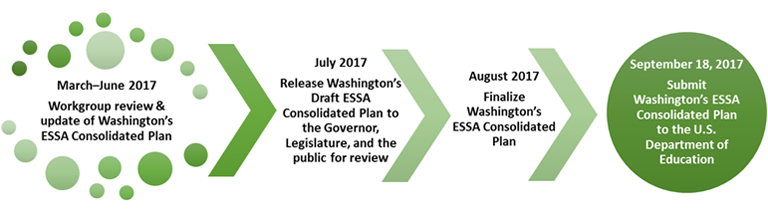
Here's a quick summary (plus green bubbles):

WashingtonESSATimeline.jpg

So, there's a timeline. What else?

They are not currently accepting public comment. There are also very few details about the actual plan itself. It's more of a plan for making a plan. Like scheduling a meeting to decide when to meet.

Read the PR buzzwords for yourself:

An accountability framework was developed in 2016 using input and recommendations from the ESSA Accountability System Workgroup (ASW). Reykdal reconvened the ASW to continue its review of some requirements in the Accountability, Support, and Improvement section of the Consolidated Plan.
In addition to reconvening the ASW, Reykdal has created a new Accountability Technical Advisory Committee (TAC). The TAC will analyze state assessment and accountability data and research-based best practices to provide recommendations or options to the ASW based on the analysis. The ASW can then make recommendations to Superintendent Reykdal.
OSPI will continue to collaborate with the State Board of Education to produce one statewide accountability framework. Also, to continue building foundations for data-informed decision-making, OSPI will align the ESSA indicators and other performance indicators to ensure a high-quality system of accountability for our schools.
“ESSA ushers in an opportunity to look at how we are supporting the needs of all students in all schools in Washington state,” said Deputy Superintendent Michaela Miller, who is leading the ESSA work. “OSPI is looking forward to developing a continuum of support that elevates a focus on equity, closing opportunity gaps, and continuous growth and improvement.”
Reykdal is also reconvening the ESSA Federal Programs Team. This workgroup will continue to:
  • align all ESEA/ESSA programs with the goal of supporting students in mastering the knowledge and skills necessary for success in career, college, and life;
  • encourage greater coordination, planning, and service delivery among programs; and
  • enhance the integration of programs under this ESEA/ESSA with state and local programs.


The press release does mention equity and opportunity gaps, but it does so in the same vague way the gaps are always mentioned in Seattle and across Washington State. Racial and socioeconomic inequities are baked into our schools, creating and perpetuating a shameful opportunity gap. Our leaders talk about how it must and will be closed! And then we carry on with business as usual.

This all sounds like more of the same so far: lots of frameworks and alignment and collaboration and enhancement and coordination and integration and continuua of support. A beehive of words, but none to inspire hope that Chris Reykdal and company will be able to solve the problems they're admitting exist.

Washington is a notoriously progressive state, and Seattle is calling itself a sanctuary city. Our education leadership needs to follow suit by making decisions and implementing policies that are unapologetically equitable. We need to be willing to make white folks uncomfortable, to risk unpopularity by doing the right thing.

Can we count on Chris Reykdal, a politician who surely hopes to get elected to some further office in another few years, to take those bold actions? To take those bold risks?

I'm not holding my breath. If it's going to happen, though, this would be a good jumping-off point. Let's start backing up our empty words about closing gaps by making our accountability plan the loudest, boldest, most unapologetic promise of equity that any state submits.

Seattle School Board VP Harris delivered the definition of a microagression to a student guest

During the Seattle School Board meeting on Jan. 18 of this year, Board VP Leslie Harris thanked a student guest and said she was "extremely articulate."

Let's take this opportunity to understand why this is a microaggression and not a compliment.

First, watch here:

Seattle Public Schools


The student in question was a young woman of color who attends West Seattle High School. She updated the board on the MLK Day assembly, then discussed her school's lack of diversity among staff and teachers, shortages in science funding, and ways to help students of color not only find success, but find pathways to the becoming teachers as well.

Seattle Public Schools


She was certainly articulate. So, what's the problem?

Let's start by turning to an excellent article from KUOW producer Jeannie Yandel, "'You're So Articulate': Why Microaggressions Wear People Down."

According to Yandel's article, a microaggression is "an everyday slight, putdown or insult toward marginalized groups. Often, these come from well-intentioned individuals who are unaware they are saying anything offensive. Such seemingly small comments are the morphing of overt racism in America into a much more subtle form of bias."

Microaggressions are a nuanced form of prejudice, which can make them easy to miss -- and to dismiss. But they take a huge toll over time, in no small part because they are so difficult to combat that they are often just absorbed silently.

More from Yandel:

If the recipient, like Sue, takes offense, he could be perceived as misreading the intent of the comment or being too sensitive. “It is very difficult for them to understand the hidden meaning of their microaggression," he said.
Microaggressions aren’t just in offhand comments – they can be nonverbal too.
An example: a white woman clutching her purse a little tighter near a black male. Sue said assumptions of dangerousness and criminality are characteristic of the microaggressions black people receive.
Each small gesture might seem trivial, but for the person who receives them, they can accumulate over years – especially if the recipient has been subjected to different microaggressions several times a day.
“All our research on microaggressions reveal that microaggressions take a tremendous psychological and physical toll on the marginalized group member,” which can take the form of loss of productivity at school and work or a decrease in subjective well-being, Sue said.
Combating microaggressions can be tricky. Sue said recipients of microaggressions find themselves in a “damned if you do, damned if you don’t” situation.
“We found that the majority of people of color did not do anything, were told not to do anything, but by that decision what happened was that it took a psychological toll on them," Sue said. "They sat there and seethed away with anger and frustration. But they were also very hard on themselves by saying, ‘I’m a coward. Why didn’t I at least do something about it?"


Of course, as the article goes on to discuss, it's usually easier said than done to "do something" about a microaggression. Imagine this young woman interrupting a well-intentioned-but-ignorant school board member to try to explain why the intended compliment was actually an insult and a projection of implicit bias.

And the thing is, she shouldn't have to. She shouldn't have to hear it in the first place, and she definitely shouldn't be the one stuck defending herself and educating her oppressors.

So, Director Harris, take it from me instead: choosing to describe this student as "extremely articulate" -- and nothing else -- is problematic. It's a microaggression. A slight. And it's yet another reflection of our school board's sad lack of racial awareness.

(See also: Let's unpack SPS Board Director Rick Burke's understanding of integrationPlease help our kids get the school board leadership they deserveSeattle School Board VP Harris should resign after using term 'ghetto school', and A grassroots coalition just stopped the Seattle School Board from adding $11 million to the deficit.)

All of our students deserve better.

I am officially raising my hand and requesting that the Seattle School Board undergo some intensive DEI (short for diversity, equity and inclusion) work. This board does not constitute safe, productive leadership for our kids.

We should also, as a so-called sanctuary city, consider taking protective measures for the kids who already live here as well as those who don't. Let's make implicit bias testing mandatory for anyone working in our public school system. Now.

The chilling implications of corporal punishment in schools without implicit bias testing for teachers


I was fortunate to be invited by ChoiceMedia.TV to host their Story of the Day video on Instagram yesterday. I chose to briefly discuss an NPR story about corporal punishment in a small-town school in North Carolina. The administrator literally keeps a paddle in his office.

David Matheson is the principal here. And he's the only high school principal in the state who still performs corporal punishment. At Robbinsville, corporal punishment takes the form of paddling - a few licks on the backside Matheson delivers with a long wooden paddle.
North Carolina state law describes corporal punishment, as "The intentional infliction of physical pain upon the body of a student as a disciplinary measure."
Robbinsville High School's policy allows students to request a paddling in place of in-school-suspension, or ISS. Last year, 22 students chose it.


That means this white man in North Carolina named David is hitting kids at a public institution with the blunt object sitting on his desk:


The NPR article avoids mentioning race and opening that can of worms, but the implications of corporal punishment doled out by racially biased teachers and administrators are chilling.

Did you know that 15 states still expressly permit corporal punishment in schools? That means in nearly one out of three states, students can legally be physically assaulted by an adult at school. Yet none of those states -- in fact, in no states at all -- mandate implicit bias testing for teachers and administrators.

Implicit bias is a primary cause of opportunity gaps and disproportionate discipline. In many ways, implicit bias is what keeps the ropes of the school-to-prison pipeline braided up. In fact, even the National Education Association has acknowledged the reality and the dangers of unaddressed biases in the classroom.

Of course, implicit biases can only begin to change when acknowledged and confronted -- as happened in this fascinating case with NBA referees unwittingly calling fewer fouls on players of their same race, only to see those statistics turn around with no intervention other than awareness.

Principal David Matheson, however, is openly uninterested in statistics or feedback. That means he's continuing to assault kids as punishment even though he's been told it's not effective. That is all too typical of public education -- a resistance to feedback, a resistance to honest self-reflection, a resistance or inability to change masked by an outward conviction that the old ways are best. To wit:

Tom Vitaglione, of the child-advocacy group NC Child, says for years he's been sending school leaders research papers showing corporal punishment leads to bad outcomes for students: higher drop-out rates, increased rates of depression and substance abuse and increased violent episodes down the road.
Principal Matheson says he's seen that research, but he still believes paddling is an effective form of discipline. "I think if more schools did it, we'd have a whole lot better society. I do, I believe that."
Vitaglione takes issue with that: "When it gets to schools, we now have an agent of the state hitting a child," he says. "And we don't believe that should happen."


To be clear, I also take issue with that. Matheson has seen the research, but he presses on with his beliefs rather than allow his sense of self to be challenged. When will we start seeing this as unacceptable behavior out of the people we are trusting to nurture and educate our kids?

Our students need to have their teachers and administrators tested for implicit bias. The adults in our schools need to confront their prejudices, both conscious and unconscious, before we trust them with the lives of our kids.

Why So Many Great Children’s Books?

By Keith Wain

When I was in grade school I read what I thought everyone else read: The Hardy Boys, and encyclopedias claiming to be picture books (they always fooled me). Oh yeah — and Encyclopedia Brown and Choose Your Own Adventures, and newspaper comic strips like Garfield or Family Circus. 

So, three or four types of books was all I thought there was, and I didn’t think there was anything wrong with that, and I didn’t wonder if there was more. 

Well, of course there was more. Judy Blume was big, so was E.B. White, Roald Dahl, and Beverly Cleary, and My Teacher is an Alien was just coming onto the scene. I didn’t read The Babysitters Club or Sweet Valley Twins; my twin brother, however, did read the Matt Christopher books, and, yes, okay, as always the classics were still being read.

So, there was quite a bit to choose from… kind of… not really… in hindsight—no, there wasn’t. 

For me, reading was boring and teachers and librarians, even my parents, pointed to the same old books or boring Hardy Boys that made watching water drip in the kitchen sink look pretty cool.

I grew up in a small town (population 800) in rural northern Minnesota. We knew how to read and the school library was well kept, but we didn’t really know what was out there. We got lucky though, because compared to today, there really wasn’t much out there to read, not for us grade schoolers and middle schoolers. So we really didn’t miss much.

Today, I am a writer, a former college English instructor, and a father of three young boys aged 8, 6, and 3. I love reading and reading to my boys, and I love writing too. I enjoy these two things so much that nine months ago I started to write my own novel for young adults. I had been sketching it out on paper and in my head for a few years before I began, but I didn’t seriously write until the older two boys started school last fall. I worked on my book religiously for seven months. Now, for the last five weeks, I’ve stopped.

I stopped because I needed to sharpen my mental writing pencil (see what I mean?). I needed to write something different because I felt my writing was getting, well, dull. But I also stopped because I had been reading tons of children’s and young adult books during those same seven months. And, if you haven’t checked out what the kids have to read today you should because there is tons of it—and tons of it is very good. 

Jeff Kinney, Dav Pilkey, and of course J.K. Rowling are three big names in the house right now, but here’s a short list of some other books that the boys and I have loved: The Mysterious Benedict Society, The Secret Series, The Penderwicks, The Fog Diver, A House Called Awful End, The Qwickpick Papers, The Spiderwick Chronicles, The Land of Stories, Guardians of Ga’hoole, The Miraculous Journey of Edward Tulane, I Survived, The Magic Tree House, and here are some brilliant graphic novels: The Creepy Casefiles of Margo Magoo, Captain Awesome , Geronimo Stilton, Dork Diaries, Big Nate, Bone, Sidekicks, Dragonbreath, The Flying Beaver Brothers, Stink, Emily the Strange, Amelia’s Notebooks, and Comics Squad. James Patterson even has several children’s book series; though I worry about the indoctrination of the young with his books. Just kidding. Kind of.

That’s a really short list to get you started.  

I didn’t think my friends and I had that variety at our hands when we were young. And according to a Statistical Abstract of the United States by the United States Census Bureau, we didn’t; approximately 2800 to 4800 children’s books were published each year between 1980 and 1989. According to a Bowker report published in 2013, today’s juvenile book publications, between 2002 and 2013 numbers ranged from 30,000 to 37,000 each year, typically staying at around 31,000. Though the numbers I’m getting from the eighties may not represent the “juvenile” range of the Bowker report, quick observation will tell you there’s a big difference. 

So what happened?! How come it took this long to get this many good books in kids’ hands? And how come so many people still go on and on about the classics as if only they can do what many of these new or newish books are doing?

Here’s what I think happened: 

Education changed because technology changed. Yes, computers. Computers have determined what can be done today. Computers created different jobs and created a different pace and change in work cycles; essentially, labor has shifted greatly toward more mental work, which means if you don’t have a good education then you will have a more difficult time finding work—work that we don’t know about yet… you know, because computers change things so quickly these days. So computers really changed the way we value and think about education. 

But it wasn’t just computers. It was also a general shift in attitudes towards children. We wanted our kids to be better educated and become more literate at an earlier age.  Jobs were changing and other countries could compete with American education and industry. In 1983, Terrel H. Bell, then Secretary of Education, created the National Commission on Excellence in Education, which produced a report titled, “A Nation at Risk.” A brief scan of this report is enough to send one into panic over the welfare of our children. Here are just two sentences from the first two paragraphs, “What was unimaginable a generation ago has begun to occur--others are matching and surpassing our educational attainments,” “If an unfriendly foreign power had attempted to impose on America the mediocre educational performance that exists today, we might well have viewed it as an act of war.” Geez! It only gets more intense the more you read.

In 1985, the American government wanted to improve literacy. In a report by the Commission on Reading, several, now obvious, recommendations were listed to improve education and create smarter kids. A couple of the most instructive for this discussion are “Children should spend less time completing workbooks and skill sheets,” and, “Children should spend more time in independent reading.” Reports like this, though there really hasn’t been any since 1985, that remind us to provide materials that are both stimulating and beneficial to young people, seemed to have been forgotten by many of our educational institutions—but not by many parents who attended at least a good year of college.

Parents certainly wanted it too. Numerous studies show how increased reading increases intelligence. Dan Hurley, an award winning journalist and author of Smarter: The New Science of Building Brain Power, is just a higher profile example of what many of us have either experienced or observed: reading when young makes you smart. 

So I think the government meant well in helping to improve literacy in America, which may have helped increase the number of books available to kids.

But, I’m sometimes wary of such commissions. After all, the government also needs to think about maintaining America as a superpower, which requires policy makers to consider who else in the world is improving, in what areas they are improving, and what the potential threats are to such improvements on said policy makers (and therefore how can the children who are human capital in a capitalist society help us). If this claim seems a little kooky, and the extreme charges against American intelligence from “A Nation at Risk” or the National Reading Commission’s report doesn’t make you wonder, look at the huge PIAAC survey done a few years ago by the Organization for Economic Co-Operation and Development (OECD). They’ll give you all the data you need on the crisis of today’s education for adults. But, then again, this organization looks a lot like those that represent the top 1% of our country, or the world. No, I’m not an expert on the OECD or such reports, but I don’t think one needs to be Noam Chomsky to feel a little suspicious.

But let’s get back to the parents. After all, aren’t they more influential than technology, the institution of education, or the government. Yes! Of course! Parents. 

Parenting styles changed. Parents became more robustly involved in their children’s academic life. In the article “A Review of the Relationship Among Parenting Practices, Parenting Styles, and Adolescent School Achievement,” published in 2005 by Christopher Spera, the ultimate conclusion is that “authoritative parenting styles are associated with higher levels of adolescent school achievement.” Kristiana Blondal and Sigrun Adalbjarnardottir came to the same conclusion, in Iceland, and in the early nineties the authors of “Impact of Parenting Practices on Adolescent Achievement: Authoritative Parenting, School Involvement, and Encouragement to Succeed,” emphasize what may now seem very clear many of us. 

Such studies and, in turn, the knowledge and application of their findings inevitably pushed more parents to look at and think about what their kids read. Furthermore, it implies that parents want the right books, engaging books that can elicit traits of academic success, which is typically curiosity and imagination. 

And these parents who became more authoritative rather than authoritarian, sometimes complained about the school worktheir kids were doing in school, some of it being, maybe, too easy or out of date. Less than two years ago many parents in San Francisco, who were most likely more engaged in their children’s academics, demanded a better curriculum for their kids (see Dr. Susan Berry’s article “Parents of Gifted Kids Protest Dumbing Down of Curriculum with Common Core”), but this parental push for better academics wasn’t and isn’t a singular occurrence. It happened in Mankato, Minnesota ten years ago, and though we’re not experts on elementary school education, my wife and I seem to be among a growing number of parents that feel our children’s education needs updating.  

This isn’t a push to privatize schools or opt for more Choice schools; it’s simply an indicator that more parents are aware of what good education looks like and they know it can be done without forms of segregation. It can be helped by good books.

So the government, good teachers, and the parents’ push for more “independent reading” and more stimulating, creative, and challenging teaching materials and practices has fed the bookstores and libraries with many more children’s and young adult books. But what about the market? Isn’t that the ultimate decision maker in publishing?

In recent years, the publishers have seen an increase in sales to parents in search of good children’s books. In an 2015 annual report by the Association of American Publishers, there are several comments like, “Parents are drawn to the format [children’s board books] since it is an effective way to introduce their children to books and reading,” and, “The children’s book clubs and book fairs market, dominated by Scholastic, have been a stable business.”

Publishers haven’t been doing too great lately, except in children’s books. In the same report by the Association of American Publishers, sales of board books in children’s and juvenile literature grew 20.2%. It isn’t all bad in adult books;  adult coloring books helped offset an otherwise stale or declining adult print market. But the long term trend in children’s books looks good for publishers, and it is an strength they intend to maintain.

This is great, right? Everyone seems on board for more books for kids.

Kind of. There is a sad fact in all this. Most of these books are about white kids and represent white realities. There’s not a lot of diversity. The Cooperative Children’s Book Center out of the University of Wisconsin provides some uncomfortable statistics about who is and is not in children’s literature. So, some kids, even with over 30,000 books published each year for them, are still going to have a hard time connecting to a book.

It is getting better, though, I think. Books like The Other Boy, whose main character is a transgender boy, Forever or a Long Long Time, Book Uncle and Me, and Lowriders to the Center of the Earth all represent characters and even perspectives that are not traditionally white. And if you look deep enough, you can find great booklists on websites like Teaching for Change Books. Many of these books are not found in libraries or big bookstores.

But one last thought on why we have more great books for kids these days. Let’s go back to technology.

The internet and greatly enhanced images in video games are awesome. They can suck anyone in and keep them engaged in a story in quite profound ways. I don’t think I need to reference academic articles to convince you that video games and the internet captivate kids. 

Today then, books have to compete with distractions unlike those ever seen before. “Electronics” isn’t just a Walkman anymore. Electronics is it—it’s all. 

Because of all this, or at least bits of all of it, good writers and publishers know that they have to up their stimulation. The characters need to be more complicated and sophisticated, and often weirder. The settings need to be more surreal or alien or silly or simply more imaginative. But the plot needs to be much more precise, more in touch with a kid’s reality and his or her interactions with ours’. The books need to be smarter. They must not take for granted that the kid reading it isn’t very insightful or aware—or smart.

This all means that there are some excellent books for our children to read today and unless you are a moral Luddite and logical goof who thinks a kid reading about animals challenging each other in profound ways or sassy boys and girls negotiating with monsters behind their parents' backs is going to cause the pithy demise of the whole universe, you will immensely enjoy yourself and your kids will thank you. 

Yes, I am still going to write my book. Yes, I am not as confident in my little story as I was before I saw what is out there today, but at least I know what I’m up against. I also realize that almost all former English teachers (high school, college, Oxford, whatever) want to write a book and be book famous. I realize I have lots of work and big dreams and lots of other people to compete against, but, hey, why not try it?

The children’s books I’ve read the last seven months have given my own writing a reality check, but more than that they have given me great inspiration to do something I would not have thought to begin but now know I can complete. Many of the books my family has been enjoying  have saved me several times from today’s political mayhem. I think some of today’s authors of children’s literature are, if not geniuses, super-duper smart and extremely creative people with enviable skills. They should be remembered for their resilience against powerful people’s crummy thoughts and actions, and their guidance toward a healthy rebellion against stale idiocy. Don’t we need more of that, especially today?

If you haven’t spent some time looking into some of the many new types of children’s books out there today, if you are still hung up on The Wind in the Willows or Little House on the Prairie, or even ones like Peter Pan and Charlotte’s Web, put them aside for a while. Let the classics rest for a bit. They’re still great books, but give some of these new ones a look because I think they’ll blow your mind.
Keith Wain is a writer and periodic professor living in Pennsylvania with his wife and three sons.

Seattle teachers vote against McCleary walkout

The Seattle teachers union voted down a proposed one-day walkout meant to pressure the legislature to fully fund its McCleary obligation.

This would hardly be unusual for Seattle's teachers. In fact, this would be their third strike or walkout in the past three school years.

We've all been agreeing for years now that we need a solution that fully funds our schools. I'm glad to see the teachers recognizing that taking a day of classroom instruction away from their students will do more harm than good at this point. Or at any rate, it's not going to apply such pressure as the legislature hasn't already been feeling.

From Paige Cornwell of the Seattle Times:

Union members who voted no questioned the effectiveness of a walkout, as well as the disruption it would cause for students and families. Lawton Elementary teacher Lyon Terry said his experiences with the 2015 walkout and strike led him to vote no on the proposed walkout.
“We walked out to fund education, but we ended up having to strike anyway,” Terry said. “My interpretation was that it wasn’t effective in that way. I don’t think this one would be, either.”
In addition to possibly changing the last day of school, students in some Advanced Placement and International Baccalaureate classes are scheduled to take exams on May 1. The AP exams, which students can take to earn college credit if they score high enough, can be rescheduled, union leaders wrote in an email to members. But the IB exams, which students in the program take to earn their IB diploma, can’t be taken on a different day. [Union President Phyllis] Campano said she has heard more concerns from members this year than the last time they voted on a walkout.


Interestingly, Seattle City Councilmembers Mike O'Brien and Kshama Sawant jointly told the city's teachers through the South Seattle Emerald, "If you decide to go on strike, we'll have your back."

I give Sawant a mountain of credit as a fearless voice for equity, but in this case, it seems like she and O'Brien might be seeing this issue for what they wish it were, rather than for what it is.

They write of the May 1 walkout as part of a larger show of resistance throughout the day, and they fold SEA's potential action in with other labor rights issues:

We applaud the incredible courage Seattle educators are showing in considering strike action on behalf of their students, their schools, and all those in our community under attack from the Trump administrations. Your bold actions are an inspiration for working people everywhere.
May 1 will be a historic day of resistance, with immigrants, women, students, and workers taking the streets across the country. In California, a coalition of SEIU locals, United Service Workers West, and workers center members (nearly 350,000 workers altogether!) are preparing to go on strike.
From the Fight for $15 to the NoDAPL campaign, Seattle’s movements of working people have again and again acted as a catalyst for change nationally. Now, Seattle’s labor movement is helping lead the way on bold May 1 action.
UAW local 4121, which represents graduate student workers at the University of Washington, are also voting on a similar strike action. And importantly, last week, the Martin Luther King County Labor Council passed a resolution in support of local unions taking strike and protest actions on May 1.
The Washington State Supreme Court has ruled that the state legislature is unconstitutionally failing to fund public education, and yet this outrage has continued for years. Underfunding of public schools impacts students of color in particular, as well as young people from low-income households.

This misses the mark for me. Teachers' rights as workers are not at stake, unless you consider the gross under-representation of people of color in the field -- 80 percent of current Seattle Public Schools teachers are white -- so this walkout would have been a students' rights issue, not a labor issue.

And, thankfully, the union voted against it in the end. I appreciate that they will maintain continuity in the classroom while finding other ways to advocate for a legislative fix for McCleary.


Why aren't we seeing any developments on Washington's ESSA plan?

Another ESSA deadline came and went like a thief in the night. Did you notice?

In case you missed it — which you probably did, because nobody’s really been talking about it — Congress revamped No Child Left Behind and renamed it the Every Student Succeeds Act (ESSA) in 2015. This new law changes a few things, but one of the most significant is that it hands over to states more control of their education systems.

One of the first steps in transitioning to ESSA is for states to submit accountability plans, essentially telling the feds how they plan to monitor themselves and hold themselves accountable within this new framework.

So, for the past year or so, states have been working on these plans, which will establish standards and accountability measures for things like upholding civil rights and serving traditionally neglected demographics.

Monday, April 3, was the first deadline to submit plans to the federal government. States were also given the option submit plans to their own governors on Monday, have them reviewed for 30 days, and then submit to the federal government by May 3. Colorado is doing that. In fact, nine states plus Washington D.C. submitted Monday, and more have announced plans to meet the April deadlne.

Here in Washington State, though, all is eerily quiet. Why aren't we seeing any developments on Washington's ESSA plan? Why is nobody -- aside from Chris Reykdal, who mentioned it once in a bizarre, obscure op-ed in the Eatonville Dispatch -- talking about it?

As I've said, it's hard to feel optimistic that Washington State, with its atrocious opportunity gaps and record of disproportionate discipline, will submit a plan to actually hold our schools accountable to standards they've never met. In fact, without vigilant public oversight, it's hard to see how our schools don't get worse through this process, which I had thought, given the current state of affairs, was inconceivable.

This whole ESSA process is supposed to include perpetual public input and feedback. Washington State has been utterly silent throughout this process. In fact, the state seems be intentionally minimizing public scrutiny — makes me all the more concerned about where we're headed.


How Walter Chen Is Building a Charter School That Reflects the Diversity of Its South Seattle Community

Walter Chen, the founding principal of a new Green Dot public middle school set to open in south Seattle this fall, has a pretty simple vision for the school: “I want it to be a rigorous, joyful place,” he said.

Simple, on the one hand, but incredibly complex when you think about what it was like to actually be in middle school. In my experience, “rigor” plus “middle school” did not typically equal “joy.”

But the more I hear him talk about it, the more I get the sense that maybe Walter, if anybody, can pull it off.

For one thing, he understands that before they can feel joy at school, kids have to first feel safe and accepted. More than that, though, he understands through lived experience the nuances of inequity in education — especially in the Seattle area, where Chen was born and raised.

“My parents were immigrants from Taiwan and always deeply concerned about education,” Chen said. “When we were really young they moved us [from Kent] to Mercer Island because they had just heard about the great public schools there.”

It took a few years for the impact of that move and for an understanding of what had been left behind, both in Kent and in Taiwan, to fully unfold, but as a young college student in Southern California, an education class led to an eye-opening experience for Walter.

“Because I got the opportunity to go out and visit schools,” Chen said, “I really was for the first time opened to the idea that not everyone has the same educational opportunities and outcomes, that your zip code, your race, your family’s income can change the complete trajectory of your life.”

Coming to understand that truth was enough to push Chen into a career in education, and after earning his BA in Economics at Pomona College and Master of Education at UCLA, he taught middle-school math in a public school in South-Central Los Angeles for six years.

“I really got to see what it was like to work in an urban school and really partner with families,” Chen said. “I got to see the impact of not just being a school employee, showing up to work and teaching kids, but spending time in the community, going out on the weekends to the soccer games and to the swap meets and things like that. It was really a true community feel.”

When Walter and his wife moved to Seattle together, he sought another highly impacted school community to serve and to call home, but he also “started thinking bigger picture,” he said.

“How could I impact more students at a time,” he asked himself, “and really make a change in educational outcomes for kids?”

His answer led him back to school, and in completing the Danforth Program for Educational Leadership at the University of Washington, he refined his view of education as an urgent social justice issue, and it marked the beginning of putting down new roots in the Rainier Valley.

After an internship at SouthShore K-8 in Rainier Beach, Chen has continued to invest in southeast Seattle, spending two years as the assistant principal at Aki Kurose Middle School and two more as the principal of Graham Hill Elementary. He and his wife and young daughter also live in the neighborhood.

“I’m just deeply invested in this community and the social, academic and emotional well-being of our kids,” Chen said, “because I know that strong schools make strong communities. Being someone who works in the community, who lives in the community, and as a person of color — specifically an Asian-American — I’m very aware that children of color don’t see many representations of themselves in their teachers and their school leaders. I believe it’s important to provide that voice.”

A rendering of the new Green Dot Middle School seen looking south on Rainier Ave. in Seattle.

For that reason, Chen hopes to build a staff at the new charter school that's as diverse as the community they will serve. He plans “as much as possible to provide opportunities for people of color to work in education, because if [students] don’t see themselves in their teachers, then we won’t have teachers who are people of color who are representative of the community. If you don’t have teachers of color, you’ll never have leaders of color either.”

It doesn't take much imagination to picture one of Walter's first students coming in this fall as a sixth-grader, leaving SPS in another seven years as a high school graduate, and then returning in another seven to teach middle school in his old neighborhood — maybe at the same school Walter's children will by then attend. And suddenly, as you consider the reality that we are always educating our babies' future teachers, building schools grounded in equity that infuse joy and acceptance into their curriculum sounds less like a pipe dream and more like the only way forward. It starts to sound like a vision for a holistic education that nurtures students as it pushes them to new heights.

“I think it’s possible to have very high expectations and high structure and a very rigorous college-prep curriculum, but when you demand that and you push kids to be the best that they can be academically and to really succeed, you also have to make it fun to come to school, and to help them feel a lot of joy in school. To take pride in their school and take pride in their community. I think that’s my ultimate vision for this Green Dot Middle School in Southeast Seattle.”


Green Dot Middle School is a tuition-free public charter school serving a diverse population in Southeast Seattle. Their mission is to help transform public education so ALL students graduate prepared for collegeleadership, and life.

Green Dot is currently enrolling incoming sixth-graders. Click here for more information.

KIRO-7 News accepting applicants for internship program for students of color

KIRO-7 News in Seattle is accepting applications for an internship program for students of color interested in broadcast journalism. Here's the full press release:


In partnership with the Northwest Journalists of Color, KIRO 7 will offer one recipient the opportunity to be an intern for the KIRO 7 News Department.

An internship at KIRO 7 provides the opportunity to be embedded in the news environment to learn about the behind-the-scenes workings of a TV and digital newsroom. Interns will assist the producers in researching stories and writing show scripts. Interns will also have the opportunity to accompany KIRO 7 news crews in the field on occasion.

In addition to learning in the newsroom, this intern will be able to meet people from other departments to understand the business of the television station as a whole. The program is open to college students.

The intern will be selected by a three-judge panel, including members of the KIRO 7 news staff and NJC program volunteers.

Download the application at http://www.aajaseattle.org/scholarships/

Internship Requirements:

  • The student must be registered at a University, College, Community College or Vocational-Technical Institute.
  • The student should have junior or senior status, or be in the last year of a Community College or Vocational-Technical program.

All internships require 20-30 hours per week covering a period of 10-16 weeks, depending on the school’s quarter or semester length. The internship starts in June.

While KIRO 7 considers the internship program format valuable in observing the student’s attitude, talents, and skills, it is understood that no guarantees are given for future employment.

Students will only be offered an internship after completing a pre-employment drug and background screening. Proof of eligibility to work in the U.S. will be required upon employment.

What do we do about federal budget cuts that target our most vulnerable kids?

By Jacq Williams

I'm struggling, listening to NPR lately. No, not the spring pledge drive. Just the daily horrors flowing out of Washington D.C.

Last week, I was driving to drop my cranky toddler off at her grandmother's house when the local NPR affiliate aired a piece on the new budget proposal, which slashes to ribbons so many social and environmental programs that it's actually difficult to figure out which one to get the most upset about. Then I heard this quote from Mick Mulvaney, White House budget chief:

"So, let’s talk about after-school programs generally. They’re supposed to be educational programs, right? And that’s what they’re supposed to do, they’re supposed to help kids who can’t — who don't get fed at home, get fed so that they do better at school. Guess what? There’s no demonstrable evidence they’re actually doing that. There’s no demonstrable evidence they’re actually helping results, helping kids do better at school."

I am not going to say that I pulled my car over and began to weep, because I didn't ... quite. I breathed deeply, gripped the steering wheel, and asked myself: Is this really it? Have we crossed over into this place? Not just the place where we have to defend feeding a child for no other reason than the fact that she is chronically hungry, but a place where a White House top official is going to claim (falsely, by every single account) that we have no demonstrable evidence that feeding children increases their test scores? As if it's not a given fact of life that when your basic survival needs are met you can focus on other things? As if that's the reason most of us would sign on to such a program in the first place?

It was unbelievable, the way those words rolled of his tongue: "Get fed so they do better at school."

I looked up the quote as soon as I parked, realizing there are only two revisions to this sentence which would make it palatable. One: A period after the words "Get fed."  Two: A complete re-phrasing: These are programs who are supposed to help children who don't get fed at home, get fed so that they do not starve. Maybe it's because I'm a mom, but I'm fairly certain it's because I'm not a sociopath, that I believe this simple fact is in-and-of-itself enough to merit the programs' funding, and that the majority of tax-paying Americans believe that a fed, thriving child is better than one who is starving to death in one of the most prosperous countries on Earth, a country that wastes nearly 40 percent of its food.

Completely unmerited claims about academic performance aside, the programs Trump is proposing to cut feed tens of millions of children every day. The School Lunch and The 21st Century Community Learning Centers Program are directed toward low-performance, high-poverty schools, and feed children living in the most dire economic conditions in the country, who are often affected by multiple social factors which can further impede future successes.

So, says The White House, let's take the students facing the difficulties of single-income households, incarcerated parents, transitional and subsidized housing, and neighborhood violence, in addition to (in most cases) all the economic and social inequities that come with being a person of color, and let's tell these same kids that now they have to starve through the school day as well. Or through the whole day, as often these programs provide the single meal the child eats in 24 hours.

And where is the money going, the money we are taking out of the bellies of America's most vulnerable populations?  To "defense." To the bombs we're dropping with impunity on other children across the world. To a wall built to protect the mirage of Great America, a country that's planning to become "greater" by completely eliminating, among so many other things, programs which fund the arts, public radio, the Clean Power Act, climate research, the Great Lakes Restoration Act, affordable housing, and public transportation -- essentially placing on the chopping block the funds for our culture, humanitarian services, and environment, all in one fell swoop.

Are we watching Trump playing Let's Make a Deal? Giving us this Modest Proposal so everything else -- things that would constitute as egregious cuts but wouldn't be entering the looking glass of a full-on cultureless, militarized state -- seem more palatable later in the process?

Regardless of his reasoning, I can't help but take this as a reaffirmation that we need to stop relying on DC to do the right, or decent, or human thing. The government has long been acting as a war-mongering, for-profit corporation, and I should probably stop feel shocked about it, and start taking more localized action. Now, even before we're offered the diet version of some of these cuts.

So what can we do about this, specifically? I am not going to pretend I have the full-fledge, mass-scale answers, but I've often been accused of speaking in grand theoretical terms and providing no pragmatic solutions, so I've compiled a list of actions we can take as singular, busy, modestly-living human beings, to attempt to mitigate some of the effects of this atrocious budget.

  1.  Identify the schools in the area which will be most affected by these cuts, and contact their outreach personnel to ask what the cuts are going to look like in practicality.
    This will provide an idea of the personalized needs of every school, where they foresee the most radical decreases in funds, and which of their programs could face closure.
  2. Start an email list which gets this information on the radar of NGO's, community members, and advocates surrounding them.
    It's easy to find the contacts for local chapters of food banks, Boy/Girl Scouts, singular philanthropists, and conscious business owners to raise awareness about what the loss of funds will look like for schools in the area. People can't help if they don't know about the problem, and it is going to take many levels of grass-roots and community activism to offset some of these deficits.
  3. Contact local branches of national corporations in the area and ask for regular donations.
    After two phone calls to the local Panera, the women's shelter for which I volunteer now gets a weekly delivery of bread and bagels. Contact local corporate restaurants, especially ones which serve short-shelf-life food like Panera or Dunkin' Donuts, and ask them to pledge to a weekly or bi-weekly delivery of their excess to ease the burden on the school. And our landfills.
  4. Hold a fund-drive.
    A simple dinner, bake sale or community bowling event in which people are given the information and opportunity to donate is a way to at least raise awareness and offer communal support for a struggling school. Of course, it won't offset the school lunch budget for an entire year, but any type of funding that can help provide more substantive meals is of huge benefit.
  5. Volunteer for after-school programs.
    After-school programs feed children snacks and meals, as well as offset the economic stress of hired care, and provide much-needed tutoring and mentoring.  Volunteering or donating to these programs is a great way to relieve some of their payroll burden, and to build community and relationships with kids from different socioeconomic backgrounds.

I truly believe these next four years are going to be dangerous and painful for the most marginalized communities in America, and that the only option with which we are left is to become the crusaders of community-based advocacy. We do have, in each of us, the power to ease even the smallest fraction of the collective suffering, and with that power comes the responsibility to show up, and to do all we can, together.


Jacq Williams is a freelance writer, homesteader, and activist from Southeast Michigan. She is currently working on an advocacy project for pregnant women in prison and transitional housing, called the Inmate Birth and Infancy Project.

Has Chris Reykdal already fallen behind as a watchdog for our kids?

We discussed Chris Reykdal, Washington's newly installed State Superintendent of Public Instruction, at great length last year. His opponent in last year's election, Erin Jones, was exceptionally qualified and the first Black woman to run for statewide public office in Washington, and we instead elected Reykdal, a white male career politician.

Now, after less than two months in office, Reykdal is already falling behind.

On Friday the Eatonville Dispatch published an op-ed from Superintendent Reykdal in which he vaguely pledged to "fight for supporters of public education."

He started by highlighting Congress' effort to repeal the regulations on school accountability (emphasis is mine):

On Feb. 9, Betsy DeVos was confirmed by the U.S. Senate as our nation’s 11th secretary of education. A few hours after the confirmation, the U.S. House of Representatives voted to repeal certain rules for the Every Student Succeeds Act (ESSA).
The rules clarify how ESSA will be implemented in regard to teacher preparation programs and how schools and districts measure success.
The Senate must now vote on the repeal. If the Senate votes in favor of the repeal, the DeVos administration will write its own rules. 

I don't expect most parents to track all the policy developments happening in our nation's capitol, but I do expect the state superintendent to keep up. The U.S. Senate voted to repeal the regulations on March 9, more than a week before this op-ed posted. 

Here's a screenshot just in case they figure it out before something posts and take it down.


Reykdal got one thing right: the Betsy DeVos puppeteers will write their own rules if left unchecked, and we can count on those rules to be oppressive in ways both familiar and newly alarming.

Let's hope this is Reykdal's wake-up call, and maybe a reminder that he's the one, as our elected champion for students, who's supposed to be on top of these things.

Standing Rock descends on the White House with sage and ceremony

By Jacq Williams

It's true, what they say: You get used to being cold. It doesn't take all that long, either. One month on the prairie and I barely noticed I was shivering all the time in the constant sodden chill; I was used to the dull ache in my throat and eyes as my sinuses clogged and unclogged, used to never getting fully undressed, to changing one bit of clothing at a time, hiding under blankets. 

It was only fitting that the Native Nations Rise March took place on a freezing, blustery wet day in Washington DC, when just the day before the temperature had neared the seventies. It was as if the tribes who had flooded the capital en masse, arriving by bus and carpooled ride, by plane and train and truck, had dragged the wind-whipped prairie to the Capital with them, perhaps to accentuate the profundity and raw elemental nature of the struggle they faced at Standing Rock. The cold has never deterred the resilience of the First Nations people to fight for the Earth, and it did not this day in Washington, either.

Over 5,000 Native Americans and their allies showed up to walk down the road to the white house, beating drums and dancing and burning bundles of sage. The air was filled with smoke, and with song, prayer, and chants:

"You can't drink oil; keep it in the soil!" 

"We exist! We resist! We rise!" 

And of course, always, "Mni Wiconi!" Water is life.

As we made our way to the National Mall, I glanced up at the suited men and women peering out the windows of the high rises, small groups of them gathered to watch the long train of people march by with our banners and drums and the puppet of the black snake, which weaved through the crowd held aloft on several sticks. I wondered what the people up in those windows were thinking, and if they always stared like that when there was a demonstration taking place, or if there was something special about this one. Something exotic and otherized in the bright colors and burning bundles of herbs.

The way they stood, gawking, made me think about how this country has always treated Native Americans: fetishizing their clothing, culture and looks, bestowing the pigeon-holing archetypes of the "Noble Savage," and at the same time stripping their basic human dignities and long-written land treaties, subjecting them to literally hundreds of years of systematic environmental racism. 

Photo by Jacq Williams.

I thought about how this march, the people who braved the prairie winter, this whole long and harrowing fight, was about violently forcing Native Americans to accept something that was deemed too dangerous for white people. I can't stop coming back to that, through all of this.

We marched. 

We marched to Trump Tower, where on the front lawn the Sioux erected a teepee, and small groups of women danced, while the men drummed and prayed as they symbolically reclaimed the stolen land of their people. I stood on a bench to see protectors snaking around blocks in either directions, dozens of tribes represented, thousands of flushed and sniffling faces who came streaming into the streets from the warm comfort of their lives to stand up for the sacred. Just as they had done at Standing Rock.

I was starting to run into more and more people I knew from camp, people we fed in the kitchen, people who taught me songs and told me secrets, and who came into our yurt at night looking to swap histories. I hugged and laughed with people I was desperate to see again, children and the women who herded them down the slippery hills at camp, the head of security, and the people who built the school among them. I knew half of them had ridden buses for days to be here. Their faces made me ache to be back on the prairie, where we interacted in such an unadulterated and archaic way, never buried in our phones or dogged down by the necessity of exchanging dollars with one another. We learned more about each other than best friends know, having to be present and integral in one another's lives from the very beginning. Having no other choice but to work together. 

We marched on, to the front gates of the White House, where I doubted the President cared enough to glance out of the window, had he been there at all.

It's a strange feeling, resisting in such a forthright and visual way, fighting for what you know is your life and the lives of your children's children, and knowing the lawmakers and lobbyists of this country have the option to just look away. The people in power, and the people at home, who don't visit news sources which would even cover something like this march, can still doze in comfort while we scream in the face of willful ignorance. 

Photo by Jacq Williams.

The Water Protectors gathered at the White House fence, chanted and held banners, and were told to get off of the sidewalk by the police and secret service, over and over again. We took pictures and burned more sage, and some people called out to the police: "Join us! Your grandchildren need clean water, too!" They were met with the blank stares of unabashed indifference. To them we were merely a possible security threat, to be assessed, addressed, dismissed.

My small group broke off and made it to the rally on the lawn. We hung around the outskirts, and were glad we did, as Dave Archambault's voice was the one we soon heard over the surrounding speakers. DAPL Dave, as he is called, is the Chairman of the Standing Rock Sioux Tribe, and it is widely believed that he made a deal with Energy Transfer Partners and the BIA to dismantle the camps—even those on the private property of Ladonna Allard—and essentially smooth the way for the pipeline's completion. 

Those who didn't know about this cheered him as his spoke his message of unity. Those who did, like Ladonna's daughter, Prairie, stood in the back and shouted their discontent. I felt the splintering, just like I had at camp, of the reality of the situation versus the perception. 

The reality, I have come to understand, is that we were never going to stop a 3 billion dollar pipeline from being completed. Not in a capitalist society which places the monetary value of commodity over life in all its forms. We were there operating under the perception, the hopeful belief, that the will of millions of Americans and the thousands of people who showed up to represent them, were enough to convince the world that the sanctity of our Native Tribes— their sacred land and their drinking water—are of more value than another faulty pipeline meant to carry oil which wouldn't even be used for American consumption. Essentially, that water/life was more important than oil/money. 

We were wrong. Despite the best of our efforts, the black snake has been built and will carry highly volatile fracked oil as early as next week.

But that doesn't mean that it was futile to gather on the prairie or flood the streets of Washington. All else aside, I don't know one person who returned home from the protest in North Dakota without a profound sense of purpose and empowerment, and a deeper understanding of the intersectionality of our resistance. Knowing, down to our marrow, that while we shout for the water we are also shouting for racial equality, environmental justice, and the reconfiguring of an economic system which keeps defense contractors buying islands while children starve on our own soil. 

Gathering like this, making camp and forming community in the face of capitalist greed, flooding the streets of Washington in winter, are in themselves acts of profound defiance. Going back to our own lives with the seeds we took from these gatherings, and planting, cultivating, and redistributing the crop amongst ourselves— that is an act of revolution. To reconfigure a pyramid-shaped system which has forever only benefitted the top, we need people on the ground who have already chosen to live a different way, who are willing to drop everything to come together in rejection of this wildly inequitable structure, to break down the pyramid and use the stones to build well-trodden paths from house to house. 

Standing Rock, and the Native Nations Rise March on DC, have proven that we have those people. That we are willing to brave the elements and our own self-doubt in order to return to a more harmonious, communal, sacred way of life, and that our numbers are growing. The truth is this: among the sleeping souls of complacency, there is an awakening of warriors for a new world who are ready to resist, and to re-imagine. At a moment's notice, ready to rise.


Jacq Williams is a freelance writer, homesteader, and activist from Southeast Michigan who spent several weeks at Sacred Stone Camp in Standing Rock in the fall and winter of 2016. She is currently working on an advocacy project for pregnant women in prison and transitional housing, called the Inmate Birth and Infancy Project.

How to Bring the Lessons of Standing Rock into the Classroom

Photo taken by Matt Halvorson on the Standing Rock Reservation in November 2016.
 

Amid the recent executive order expediting the construction of the Dakota Access Pipeline on the Standing Rock Reservation, teachers inside and outside the community must continue to engage their students and reflect on both its impact and historical context.

The movement to protect the sacred lands of the Oceti Sakowin (the Seven Council Fires of the Lakota, Nakota, and Dakota Nations) not only united a network of tribal nations and allies, but also sparked long overdue—and sometimes difficult—discussions on a multitude of complex issues, including environmental protection, tribal sovereignty, racial oppression, privilege, and access to power.

While the Sacred Stone Camp has been disbanded, teachers can still engage students in this dialogue and keep this issue—and the history of Native people and lands—in the national consciousness. Below are some resources and suggestions for teachers to leverage now:

Photo taken by Matt Halvorson on the Standing Rock Reservation in November 2016.

Photo taken by Matt Halvorson on the Standing Rock Reservation in November 2016.

  1. Get the facts. Discover the historical context of the events leading to Standing Rock with this brief primer from KGW-TV in Portland and a more detailed version from NYC Stands with Standing Rock titled the #StandingRockSyllabus.
  2. Understand firsthand perspectives. Read an account of the protests from Robert Cook, who leads Teach For America’s Native Alliance Initiative. Also be sure to visit an inspiring piece from Tariq Brownotter, a senior at McLaughlin High School in South Dakota who ran more than 500 miles from South Dakota to Washington, D.C., as part of a Dakota Access Pipeline Awareness run. The Washington Post and National Geographic have more voices from the Sacred Stone camp. (RUFS Note: read more about Matt Halvorson's experience at Standing Rock on the Rise Up For Students blog)
  3. Create a powerful lesson. Several news organizations have put together downloadable lesson plans that cover the conflict from a variety of viewpoints in both print and video, including National Geographic, The New York Times (here and here), and KQED-TV, San Francisco’s PBS affiliate. Aside from news outlets, check out this page from Teaching Tolerance, a project of the Southern Poverty Law Center, which offers ways for educators to make Standing Rock accessible to students across a range of subjects.
  4. Teach stories of youth activism. You can also view a collection of resources from The Choices Program, which focuses on youth activists’ role in this and other social movements.
  5. Stay engaged. Learn more about organizations advocating for the rights of Native communities:


An original version of this post originally appeared on TeacherPop. Reposted with permission.

Brought to you by Teach For America, TeacherPop provides real talk, tips, and activities that teachers can use in the classroom. Writers offer advice for all of the challenges new teachers face, sharing everything from difficult reflections on their darkest days to quick tips for sprucing up their classrooms and their lives.

Yesterday Trump honored the racist Bryan Adams lookalike Obama tried to leave behind

Donald Trump laid a wreath on the grave of former President Andrew Jackson yesterday on what would have been Jackson's 250th birthday.

It turns out Trump is the latest in a long line of presidents who have paid homage to Jackson. Reagan, Lyndon Johnson and Teddy Roosevelt, among others, all visited Jackson's home and adorned their predecessor's grave while in office.

But why the persistent interest in Old Hickory? (Evidently that was Jackson's nickname, by the way -- Old Hickory. As a one-time ballplayer, I'm jealous. Anybody called Old Hickory could probably hit like the dickens.)

Well, for one thing, he was a white man in America, which means that his thoughts, words and deeds were and continue to be considered inherently more important and more valuable than those of most people around him.

Further, like many of his similarly heralded colleagues, Jackson was a sanctimonious slaveowner who was directly responsible for the murder of many, many indigenous people, and for the forced relocation of many more. He rests on the same prickly laurels as Washington and Jefferson and our other most star-spangled heroes.

Even Barack Obama paid Jackson some (un)love. Barry made an effort during his time in the Oval Office to have Jackson's likeness removed from the $20 bill, paying his subtle respect to Jackson through the "any publicity is good publicity" avenue. I'm told that effort fell short, but I haven't seen a bill the size of Jackson's in years now.

It should probably be no surprise that Jackson -- and his views on race -- remain relevant. Our country has shown time and again that oppression and violence against people who aren't white men is enough to keep you celebrated for centuries. But in Jackson's case, there may be more to the story -- a conspiracy worthy of Doc Brown's DeLorean.

I don't believe any of these presidents are visiting the grave of Andrew Jackson. They are visiting Andrew Jackson himself.

Don't believe me?

Then how did Andrew Jackson release a piano-pop album as "Bryan Adams" more than 200 years after his "death?"

I don't know.

What I do know is that Wikipedia credits "Bryan Adams" with the following on Reckless

Bryan Adams – lead vocals, guitars, piano, harmonica, hand claps, foot stomping

"Hand claps, foot stomping." That's very weird... just like everything I've written here. Coincidence? Bryan Adams thinks so.

Anyway, you know what else is weird? It's hard to look at who our country chooses to honor and who it chooses to forget (for instance, honoring Jackson on the $20 bill and forgetting every person of color and most women) without thinking we are intentionally working to maintain the racial hierarchy Trump is being so honest about.

We can't forget that Andrew Jackson is the founding legacy of the Democratic Party, but we can stop treasuring his memory.

We shouldn't forget the legacy of oppression and destruction left by Old Hickory and his white-power brethren, but until we stop considering them emblems of patriotic morality, I fear we are doomed to perpetuate the shadows of our past.

It's time to be brave enough to build a future that doesn't build on the oppressive values of its founders. It's time to recognize new standard-bearers and hold them to a higher moral standard, as Reckless as that might seem.

And it's time to take Bryan Adams off the $20 bill.

Saturday is Enrollment Day at Tacoma's Destiny Middle School

Destiny Middle School will be enrolling current 5th, 6th and 7th graders from 10 a.m. to 1 p.m. on Saturday, March 18 at its third annual Enrollment Day. Interested parents, students and community members are invited to visit Destiny, part of the Green Dot network of charter schools, at 1301 E. 34th St. in Tacoma, Wash.

Washington State's charter schools are showing success closing opportunity gaps created by our traditional public school system, and Destiny may be the cream of the crop. It's worth checking out.

Students can be fully registered at the event. Food and kids' activities will be provided.

Check out the event page on Facebook for more info.

Green Dot Destiny Middle School in Tacoma, Wash.

Green Dot Destiny Middle School in Tacoma, Wash.

Signs of Hope in South Seattle

I wrote earlier this month about the many different positive messages people have posted in their yards in my neighborhood, and how there's some power in these quiet, steady displays of love.

I accidentally drove down a side street off McClellan a couple days ago and saw the same style of Black Lives Matter sign in almost every yard. By the end of the block, I was choked up. Granted, I'm pretty easily weepy these days, but still, it made me wonder: what if the whole city looked like that? I bet that's what a sanctuary city would really look like.

Let's unpack SPS Board Director Rick Burke's understanding of integration

We have a dysfunctional school board in Seattle, and that has been fully on display in discussions about opening a new elementary school in North Seattle's Cedar Park neighborhood.

The north side of Seattle is an overall whiter and more affluent community than the south end, but most Cedar Park residents are people of color and, it so happens, average a lower income than folks in the surrounding neighborhoods.

A group of north-end parents saw a school comprised almost entirely of students from these under-served demographics as doomed to low achievement. They formed a coalition and wrote a letter that eventually found its way to the school board suggesting Cedar Park Elementary open as an option school instead of a neighborhood school.

The board liked this idea.

"I think we have an opportunity to shine here," said board VP Leslie Harris during the Nov. 16 board meeting, "and to make lemonade out of what potentially was a big lemon in setting up a ghetto school."

Seattle Public Schools

“To open Cedar Park as an attendance-area school with potential of high concentration of disadvantaged learners feels like a disservice to the community," Dir. Rick Burke said during the same meeting (in the video at 1:53:00), "but combining the community demographics with a natural tendency of an option school to draw in more affluent families provides a natural balance to demographics.”

Burke is inferring here that a school needs "more affluent families" (code for "more white families," whether he is conscious of that or not) to make a school worth investing in. Referring to a school without those affluent families as "a disservice to the community" shows that on some level, Burke knows the district won't be able to adequately educate the kids in Cedar Park.

SPS has the fifth-worst opportunity gap in the nation and a documented history of disproportionate discipline of students of color. If the district opens a new school made up entirely of those pesky demographics, the entire board knows they will fail to give those kids an excellent education. "Balancing demographics" helps balance overall test scores and overall outcomes. It allows the board and the district to continue to perpetuate opportunity gaps along racial and socioeconomic lines without doing so in a glaringly obvious way. It allows them to avoid addressing the systemic problems within the district that create these gaps in the first place.

Turning Cedar Park into an option school displaces the local community as well, which means this plan represents a well-disguised form of gentrification. Option schools are modern-day "white flight schools." This is will happen with Cedar Park as it has happened elsewhere.

Burke and Harris show that they know this, but again, they do it very subtly. "Disadvantaged learners" is code for "students of color." Knowing that creating an option school would even out those demographics shows an understanding that it would bring gentrification. It's just that they see that as a good thing.

School integration is a tricky issue, in no small part because it's trying to buck the reality of our segregated lives and our segregated society, but it's one of the only initiatives that has truly helped eliminate opportunity gaps.

Some argue, without using these exact words, that the white/affluent kids are so "advantaged" that they'll elevate the class around them, essentially -- that "advantaged learners" will rub off on the poor, unfortunate souls around them.

That's an unfortunate misunderstanding.

Genuine diversity in a school allows more strengths and learning styles to flourish. There is inherent value in diversity and differing perspectives.

And as far as schools go, the numbers are clear: a more white/affluent student body means better teachers and teacher retention, stronger external funding, stronger principals and leadership -- stronger privilege, essentially. Through integration, that privilege is spread out a bit more and is made available to more students of color, giving them easier access to wealthier PTAs, to more privileged teams and organizations and people.

It's not that sitting next to a white kid makes a kid of color smarter. It's that they actually get access to higher-quality elements of the inequitable system.

Historically, however, white families and families of privilege have resisted integration. The only way to actually solve this problem has been to put together policy, pass potentially controversial legislation even in the face of pushback, and do the hard work of changing hearts and minds of people with privilege.

Change is scary. We of privilege don't tend to give up our privilege voluntarily. We push back against threats to the status quo, even if we don't fully realize or articulate what we are doing or why. For our inequitable systems to change, we have to be prepared to make and stand by unpopular decisions, or we need to be honest with ourselves and know that we are failing the students who most need a voice.

Please help our kids get the school board leadership they deserve

I'd like to point your attention toward the dysfunction of the Seattle School Board. Many of the directors on the board have consistently shown a troubling lack of racial awareness, and it's been having a seriously negative impact on the kids in our district for many years.

Dir. Leslie Harris described a Cedar Park school full of low-income students of color as "a ghetto school."

It's time for things to change.

I wrote a blog post Sunday about Dir. Leslie Harris, the recently appointed board vice president who used the term "ghetto school" during a board meeting last November. It sparked a particularly inspiring response from one former principal.

This earlier post also gives some more background on the problematic dynamics on the board:


A grassroots coalition just stopped the Seattle School Board from adding $11 million to the deficit


These are just a couple examples, of course. I'll also be writing this week about Dir. Rick Burke's troubling take on integration and about more racially sleepy comments from Dir. Harris.

Seattle Public Schools has documented problems with disproportionate discipline of Black students, and the district is home to the fifth-worst opportunity gap in the nation. These are more than just politically incorrect slips of the tongue from a well-intentioned board of directors. Each microagression and each offensive phrase represents the pattern of thinking that still guides our schools. 

The West Coast is leading the resistance against the Trump-led Republicans, and Washington State has been at the forefront of that movement in a very real way. On a local level, however, we still have elected officials making oppressive decisions -- especially when it comes to education. It's time that our local politics better reflect our bold commitment to equity.

If you have more stories illustrating our problematic school board in Seattle -- and I'm sure you do -- please share them with me. We need the voters in our city to know who is representing their kids and their schools.

Thanks for reading, and thanks for everything you're doing to create better schools and a better world for our kids. They need us to rise up now more than ever.